Small Cap, Big Innings: A Cricket Guide to Small-Cap Fund Investing
Explore small-cap fund investing through cricket, understanding growth opportunities, market risks, the importance of a long-term holding period, and how SIPs can help you navigate market volatility.

Every big innings starts small. A nervous first single. A streaky boundary that barely carries. A young batter walking out to a crowd that doesn't know their name yet. Nobody remembers the first ball of a match-winning knock; they remember the total it became.
Small-cap mutual fund investing can be viewed in the same light. The businesses that may grow into meaningful contributors to a portfolio rarely look impressive at the start. They begin small and unnoticed. Investors who understand the segment, invest with patience and stay invested through market cycles may participate in their journey.
This guide uses cricket to walk through how they work, what the risks are, and how long investors typically need to stay invested.
What Is Momentum Investing?
At SAMCO, we call ourselves The Momentum House, and the name comes from a simple cricketing instinct: good captains don't pick a team on reputation, they pick it on form. A player who was brilliant two seasons ago but has gone quiet recently makes way for someone who is finding the ball, reading the game well and delivering right now.
That's the lens we bring to investing. Rather than picking stocks purely on size, brand recognition or past reputation, a momentum-driven approach looks at what the numbers are saying today (price trends, earnings growth and revenue momentum) to identify companies showing signs of momentum. It's less about who had the best season a while ago, and more about who is playing well this one. This philosophy is central to how we approach investing, and especially to how we think about small caps.
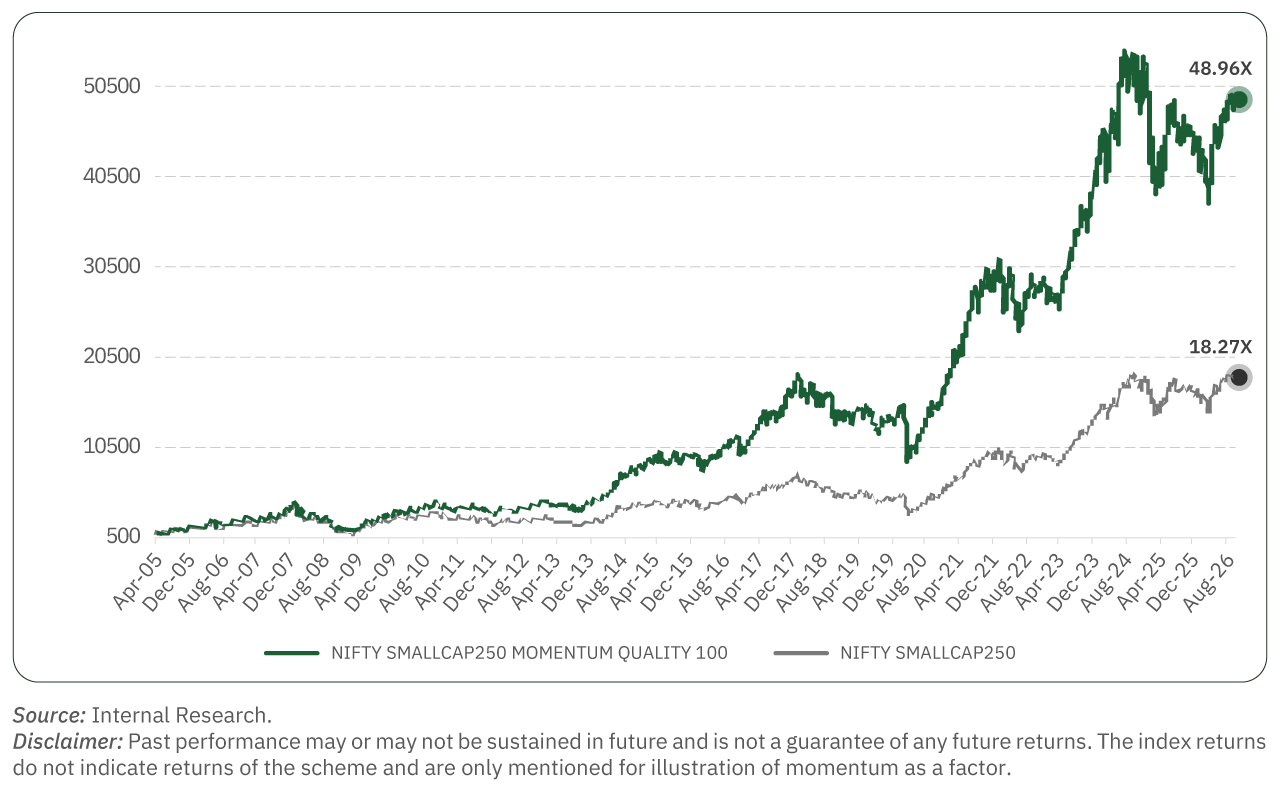
To see what staying “in form” has looked like historically, here is how a momentum-and-quality-screened basket of small-cap stocks has performed relative to the broader small-cap universe over roughly the last two decades:
Understanding the Uncapped Talent: Small-Cap Fund Risk
Every squad carries a player who hasn't had a full international season yet: someone with real match-winning potential, but also the unpredictability of a player still finding their range at this level. Backing that player takes a certain risk appetite and a longer view of where they can get to.
Small-cap stocks occupy exactly this space in a portfolio. These are smaller companies, ranked well beyond the usual large-cap names, with potential for growth as their businesses develop. They can accelerate quickly when conditions favour them, and they can go quiet just as fast. Your own risk appetite decides how much of your batting order you're willing to build around players still proving themselves: those who may offer significant growth potential, but also a wider range of outcomes.
It's worth seeing that range, not just describing it. The chart below tracks drawdowns (how far an index has fallen from its most recent peak) for the Nifty Smallcap 250 and a momentum-quality-screened version of the same universe, over roughly two decades.
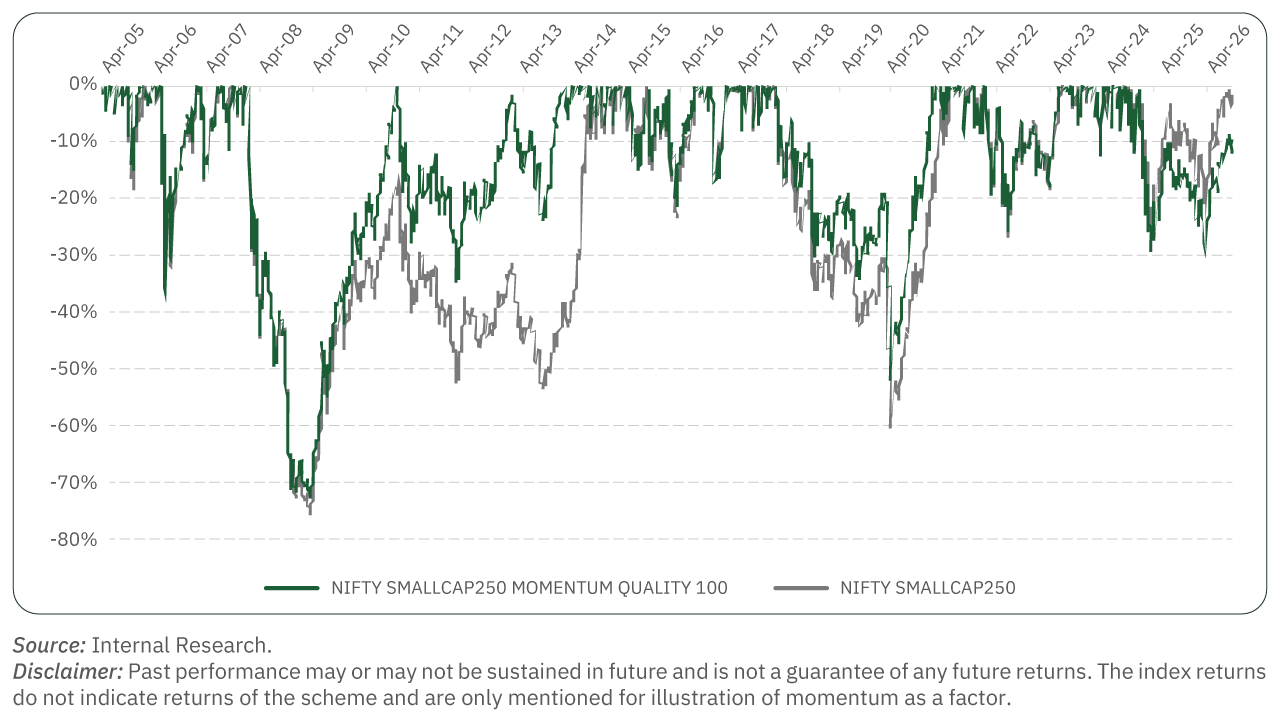
Notice the shape: long stretches of recovery, interrupted by sharp, sometimes brutal pullbacks. There was a fall of roughly 70–80% through the 2008 financial crisis, another sharp drawdown of around 50–60% during the 2020 pandemic, and smaller corrections in between. This is what “a wider range of outcomes” looks like in practice. A momentum or quality tilt doesn't exempt a stock, or an index, from these drawdowns; both lines fall together in the sharpest sell-offs. What a disciplined, form-based process can influence is how a portfolio is built and rebalanced through these cycles, not whether declines happen at all.
The lesson isn't to avoid the uncapped player. It's to size the bet appropriately, and to be honest with yourself about whether you can stay at the crease through a 50–70% dip without walking off mid-innings.
Small-Cap Allocation: Building a Full Squad, Not Just One Type of Player
No team wins with eleven aggressive stroke makers and nobody to anchor an innings. The best sides balance stability with intent: different players suited to different match situations, brought together into one XI.
A portfolio needs the same balance. An allocation to small caps can play a role in your overall portfolio, but it works best as part of a wider squad, sitting alongside large-cap stability and mid-cap growth, not as a replacement for either.
Playing the Long Format: Small-Cap Holding Period
T20 rewards instant impact. But the innings that get remembered, the ones that define a career, are usually built over a full match, sometimes over a full series, not one explosive over. Selectors backing a promising young talent do it with patience, judging them over seasons, not a single failure or a single flash of brilliance.
Small-cap investing asks for that same patience. It's built for investors thinking in terms of a full career, not a single innings, which is why SAMCO suggests an ideal holding period of around 7 years for small-cap exposure.
The numbers offer an interesting perspective. Looking at rolling daily returns of the Nifty Smallcap 250 Momentum Quality 100 Index against the broader Nifty Smallcap 250, the share of instances in which the index outperformed has historically risen as the holding period lengthened
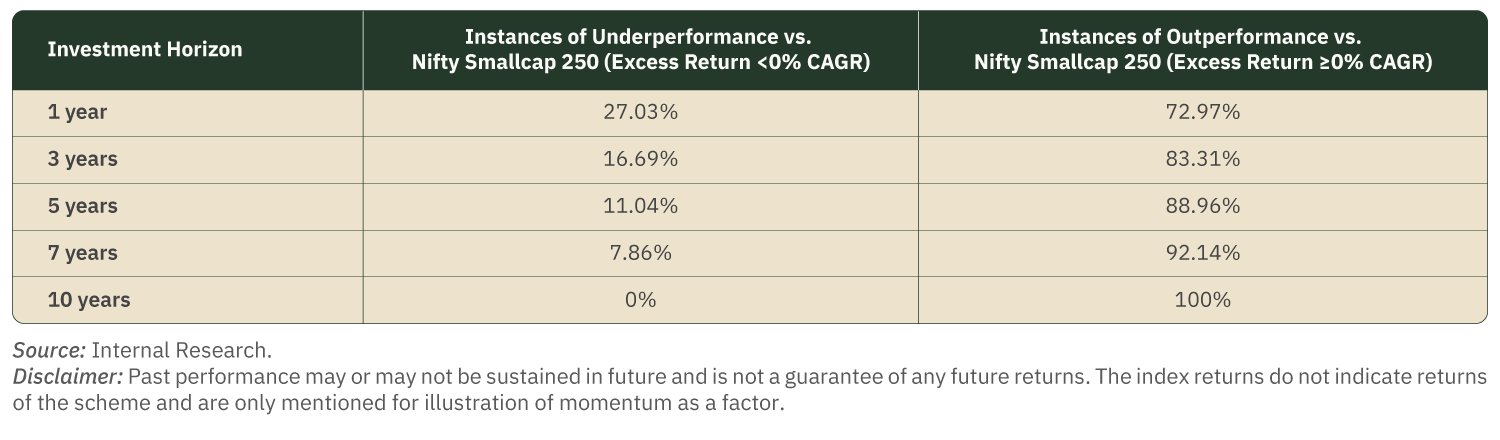
This is historical index-level analysis, not a guarantee. But the pattern is consistent with the broader idea: a short innings leaves more to chance, while a longer one allows more time for the effects of quality and momentum to be reflected in the numbers.
Building the Innings: SIP vs. Lumpsum in Small-Cap Funds
No batter walks out and swings at the first ball hoping to clear the ropes. Good innings are built delivery by delivery: a single here, a well-placed two there, the total climbing with intent rather than luck.
A Systematic Investment Plan (SIP) works with similar discipline. Instead of trying to time one large lumpsum entry, essentially betting the whole innings on one well-timed shot, you invest a fixed amount regularly and let time and consistency play out across market cycles, not just one match. It's a quieter way to bat, and can be one way to build an investment journey over time.
Staying at the Crease When the Pitch Gets Difficult
Every long innings has a spell that doesn't go to plan: a testing spell of bowling, a rough patch of form, an over that simply won't yield runs. The batters who survive it, rather than throwing their wicket away in frustration, are usually the ones still there when the total looks very different by the end.
Small-cap markets test investors in exactly this way. Volatility isn't a sign the strategy has failed; it's part of the format. Staying invested through such phases can be important for investors with a longer investment horizon, while recognising that there is no assurance that the innings will finish big or that losses will be recovered.
Where This Comes Together: The SAMCO Small Cap Fund
This is the thinking behind the SAMCO Small Cap Fund, a fund built entirely around The Momentum House view of the market, and designed for investors willing to back a small start long enough to see it become something bigger.
The fund uses SAMCO's proprietary C.A.R.E. momentum strategy, reading Cross-sectional, Absolute, Revenue and Earnings momentum, to identify small-cap companies (broadly, those ranked 251st to 750th by market capitalisation) showing current momentum, based on its investment approach. It is benchmarked against the Nifty Smallcap 250 TRI, carries a Very High risk rating (as on Sept-26) in line with the small-cap category, and is built with a long-term view: an ideal holding period of around 7 years.
You can start with a lumpsum investment of ₹5,000 or an SIP from ₹250. A 1% exit load applies on redemption or switch-out within 30 days of allotment; there is no exit load thereafter. Every big innings starts with a first run. The question is whether you're willing to stay at the crease through the ups and downs of the game, while understanding that investment outcomes are not guaranteed.
To know more, please read the Scheme Information Document (SID) and Key Information Memorandum (KIM) carefully.
Explore the SAMCO Small Cap Fund →
Frequently Asked Questions
What is a small-cap fund?
A small-cap mutual fund is an equity mutual fund that predominantly invests in small-cap companies. Under the applicable SEBI classification, small-cap companies are those ranked 251st onward by full market capitalisation.
Is the SAMCO Small Cap Fund high risk?
Yes. It carries a “Very High” risk rating on the SEBI Riskometer, and the benchmark also carries a “Very High” risk rating. Investors should consider their investment objective, risk appetite and investment horizon before investing.
Are small-cap funds good for the long term?
Small-cap funds invest in smaller companies and can experience significant volatility and drawdowns. They may be considered in a long-term investment strategy depending on an investor’s goals, risk appetite and investment horizon. Historical performance does not guarantee future returns.
Can small-cap funds give negative returns?
Yes. Small-cap funds are market-linked investments and can experience periods of negative returns, particularly during market corrections or periods of higher volatility. Past performance does not guarantee future returns.
What is the difference between small-cap and mid-cap funds?
Small-cap and mid-cap funds invest in different segments of companies based on their market-capitalisation ranking. Under the applicable SEBI classification, large-cap companies are ranked 1st to 100th, mid-cap companies 101st to 250th, and small-cap companies 251st onward by full market capitalisation.
Should I invest in a small-cap fund through SIP or lumpsum?
Both routes are available in the SAMCO Small Cap Fund. A SIP involves investing a fixed amount at regular intervals, which can help spread investments across different market levels and reduce reliance on the timing of a single investment. A lumpsum investment involves investing a larger amount at one time, making the timing of that investment more relevant to the investor’s experience.
What is momentum investing?
Momentum investing is a strategy that identifies stocks showing strong recent momentum in price, earnings or revenue trends, rather than selecting stocks purely on size or past reputation. Past momentum may not continue, and the strategy does not assure future performance.
What is the SAMCO Small Cap Fund's investment strategy?
The fund uses SAMCO's proprietary C.A.R.E. momentum strategy, which evaluates Cross-sectional, Absolute, Revenue and Earnings momentum to identify small-cap companies, broadly those ranked 251st to 750th by market capitalisation, based on the strategy's defined investment parameters.
What is the recommended holding period for a small-cap fund?
SAMCO suggests an ideal holding period of around 7 years for the Small Cap Fund. The appropriate investment horizon can vary depending on an investor’s goals, risk appetite and financial circumstances.
How are small-cap funds taxed?
Taxation of small-cap mutual funds depends on the applicable tax rules and the investor’s holding period. Tax regulations can change, so investors should refer to the latest applicable tax provisions or consult a qualified tax professional before making investment decisions.
What is the minimum investment in the SAMCO Small Cap Fund?
The minimum lumpsum investment is ₹5,000, and SIPs can be started with as little as ₹250, both in multiples of ₹1 thereafter.
What is the exit load on the SAMCO Small Cap Fund?
A 1% exit load applies if the investment is redeemed or switched out on or before 30 days from the date of allotment of units. No exit load is charged thereafter.
What is the benchmark for the SAMCO Small Cap Fund?
The fund is benchmarked against the Nifty Smallcap 250 Total Returns Index (TRI).
Mutual Fund investments are subject to market risks, read all scheme related documents carefully.
Samco Mutual Fund | MF/077/21/03