Can Momentum Investors Expect Higher Returns?
Momentum strategies are designed to move differently from the broader market, understanding this can help investor set the right expectations.

If you've ever compared a momentum fund's performance chart with the Nifty 500, you've probably noticed something odd. It just doesn't always move the same way.
During certain market phases, momentum strategies may participate more strongly in rising markets, while during other phases, they may experience sharper declines. At times, the fund's performance can even move inversely to the broader market falling on days when the index rises or climbing when the index falls. In other stretches, it moves in the same direction as the market but at a noticeably different pace, outpacing the index on the way up or lagging well behind it. And sometimes, it moves in a way that seems to have little to do with "the market" at all. But eventually in the long run momentum investors get asymmetrical returns.
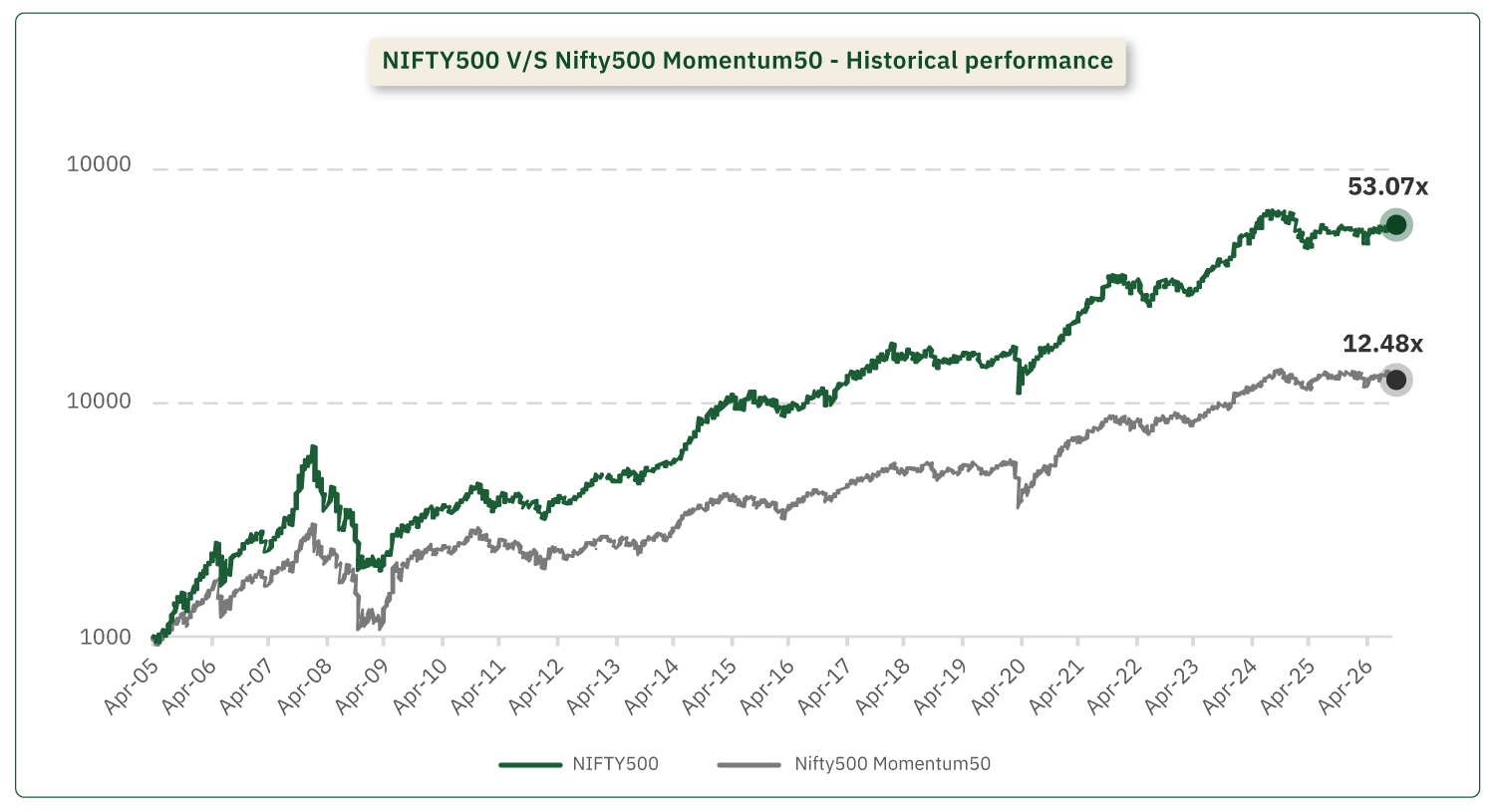
Source: Internal Research
Disclaimer: Past performance may or may not be sustained in future and is not a guarantee of any future returns. The index returns do not indicate returns of the scheme and are only mentioned for illustration of momentum as a factor.
If you're used to a regular diversified fund that moves in line with the index, all this divergence can feel concerning. Why is this fund behaving so differently from the market you're used to?
It's simply doing what it was designed to do. So instead of asking "why is this fund behaving oddly?" the better question is: "why does momentum, as a strategy, move differently on purpose?"
Key Takeaways
- Momentum funds are built to follow price strength, not to mirror the market, so their returns naturally de-link from broad indices.
- This is exactly why momentum can look "lumpy": strong run-ups when trends hold, sharper drawdowns when trends break.
- Active and Passive momentum funds work on different rulebooks, and even two active funds can behave very differently.
- Momentum is a strategy best judged over years, not days, and its performance depends heavily on the kind of market it's operating in.
Rolling Return Analysis: NIFTY500 Momentum 50 vs NIFTY 500 (21-Year History) The longer momentum is given to work, the more consistently it has outperformed the broader market:
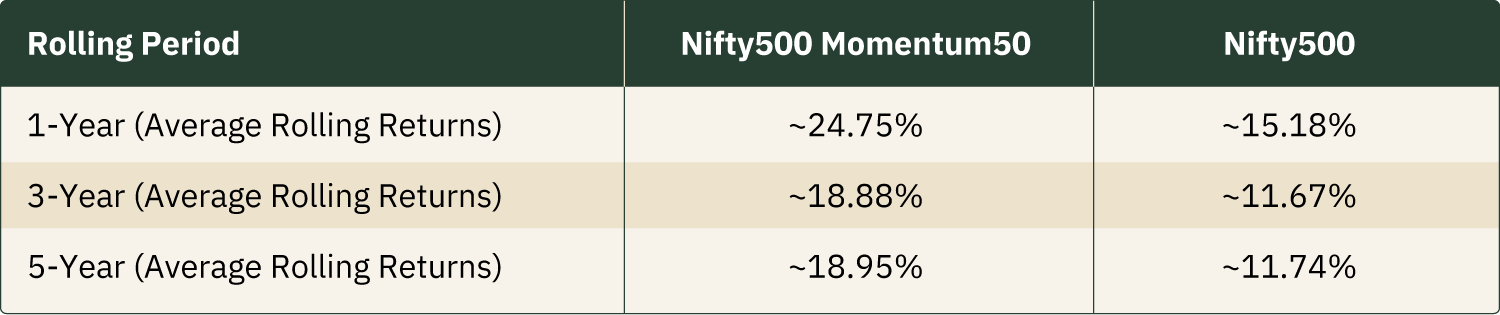
Source: NIFTY500 Momentum 50 Index vs NIFTY 500 Index, data as on 10th September 2026.
Disclaimer: Past performance may or may not be sustained in future and is not a guarantee of any future returns. The index returns do not indicate returns of the scheme and are mentioned only for illustration of momentum as a factor.
Momentum isn't trying to copy the benchmark, it's trying to follow strength shown by individual stocks in their recent price movement
A diversified fund typically invests across a range of sectors and companies, providing exposure to different segments of the market. As a result, its performance may broadly reflect the direction of the overall market, while also being influenced by the securities and sectors it holds.
A momentum fund follows a different approach. Rather than seeking broad exposure across the market, it seeks to identify stocks or sectors that are showing relatively strong price trends and allocate to them based on the strategy's investment process. This is where the lumpiness can come from.
Because a momentum fund's portfolio is positioned towards securities exhibiting stronger price trends, its performance can differ meaningfully from the broader market. When trends remain strong, momentum strategies may benefit from the continuation of those trends. But when trends weaken or reverse particularly during choppy markets or sharp changes in market direction securities that previously showed strong momentum may lose that strength, potentially leading to periods of underperformance or heightened volatility.
That's the nature of the cycle: periods where established trends may work in favour of the strategy, interspersed with periods were changing or reversing trends can create volatility and losses.
"Active" momentum vs "Passive" momentum, the difference you need to know
Active and passive momentum strategies can differ in how they identify, select and allocate to stocks, and these differences can influence how they behave across market cycles.
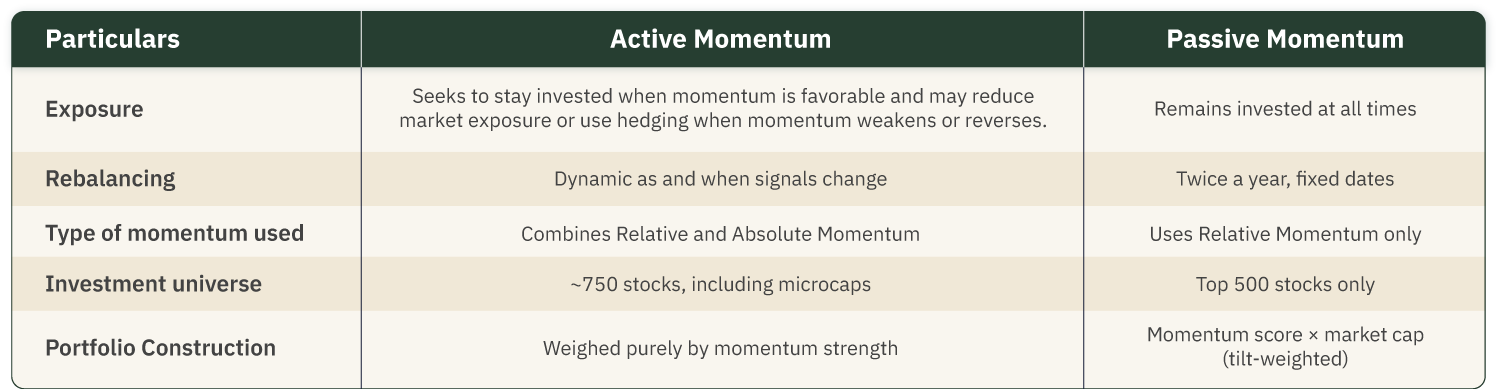
Passive momentum's rulebook is fixed by design. "Active momentum," on the other hand, is really an umbrella term, it covers very different approaches depending on the manager. Here's where that variation shows up.
Within Active Momentum, no two managers build the same fund
Even among active momentum funds, two managers can make very different choices and end up with very different portfolios, despite both calling their fund "momentum."
Universe choice matters: A strategy focused on a narrower universe of companies may have different risk and return characteristics from one that considers a broader investable universe. Expanding the universe can provide access to a wider range of securities and trends, while also introducing different levels of volatility and liquidity considerations. Some managers may also use quality or stability filters alongside momentum, seeking to combine trend-based selection with additional portfolio considerations.
Look-back period is another important consideration: A shorter look-back period may respond more quickly to recent changes in price trends, while a longer period may place greater emphasis on more established trends. Some managers may combine multiple timeframes as part of their investment process.
Rebalancing approach matters too: A fixed schedule is predictable but can lock in a portfolio right at a peak, while a dynamic, trend-based approach is more responsive and can reduce the impact of a sudden momentum crash, at the cost of predictability. Each approach has its own trade-offs, including considerations around transaction costs, timing and portfolio turnover.
Downside protection is another area where approaches can differ, staying fully invested captures the full momentum move in both directions, tactical hedging lowers drawdowns but usually caps the upside, and a valuation or quality screen offers a smoother ride at the cost of occasionally missing the biggest moves.
What this means for how you evaluate a momentum fund
Since momentum is designed to move differently, judging it the same way you'd judge a regular diversified fund doesn't quite work. A few things are worth keeping in mind instead:
- Look at how the fund is built, not just its name - Which stocks it can pick from, how far back it looks, and how often it changes holdings all shape how it behaves
- Expect a bumpier ride, that's by design - Sharper ups and downs, especially when trends reverse, aren't a sign something's wrong. They're simply part of how this kind of strategy works.
- Check if it's active or passive, and if active, how - This tells you whether the fund's movement comes purely from an index, or also reflects a fund manager's decisions on universe, look-back period, rebalancing, and downside protection.
- Think in years, not days - Momentum tends to prove itself over a longer stretch of time, not from watching it day to day.
- Consider what kind of market you're investing in - Momentum tends to shine in a trending market and struggle in a choppy or reversing one worth keeping in mind alongside your own time horizon.
The Momentum House View
At Samco Mutual Fund, we call ourselves The Momentum House for a reason: momentum isn't just a return pattern to chase, it's a mechanism to understand.
You don't need to be a market expert to make sense of it. Once you know why momentum moves the way it does the design behind it, the behaviour driving it, and the reasons one momentum fund can differ from another, a choppy-looking chart stops feeling confusing. It starts making sense, whether you're a first-time investor or someone who's tracked markets for years.
That's the understanding we want every investor to walk away with, not just the ones who read the fine print.
If you're evaluating a specific momentum scheme with this lens in mind: as with any equity-oriented investment, the scheme is subject to market risks, and investors should consider the scheme's investment objective, investment strategy, risk factors and their own investment objectives and risk appetite before investing. Investors are advised to refer to the scheme-related documents for complete details.
For the full research paper on momentum indices, visit the NSE Indices research paper library at niftyindices.com/reports/research-paper and select the relevant momentum index (e.g., NIFTY500 Momentum 50 or NIFTY200 Momentum 30).
Frequently Asked Questions
Why do momentum funds fall more than the broader market during corrections?
Momentum strategies may have exposure to securities that have recently exhibited strong price trends. When market sentiment or trends reverse, these securities may also experience significant declines. Depending on the portfolio and market conditions, this can result in periods of heightened volatility or drawdowns.
Is momentum investing riskier than investing in an index fund?
Momentum strategies carry equity market risk, and their risk and volatility can differ from those of broad-market indices. The level of risk depends on factors such as the investment universe, portfolio construction, diversification, rebalancing methodology and risk-management approach. Investors should evaluate these characteristics against their own risk appetite and investment objectives.
What is a momentum crash?
A momentum crash refers to a sharp, sudden reversal in a momentum strategy's performance, typically occurring when previously strong-performing stocks fall out of favour rapidly and simultaneously. It reflects the same behavioural forces that build momentum working in reverse.
How does momentum perform differently in a bull market versus a correction?
Momentum strategies may benefit when established price trends persist. However, when market trends weaken or reverse, securities that previously demonstrated strong momentum may also experience declines. As a result, momentum can perform differently across market environments, and there is no assurance that it will outperform during any particular market phase.
Can two active momentum funds have very different risk profiles even though both are "active"?
Yes. Active momentum strategies can differ in their investment universe, method of identifying momentum, look-back period, portfolio construction, rebalancing approach and risk-management framework. These differences can result in different portfolios and different risk and return characteristics, even when the funds follow the same broad momentum philosophy.
Mutual Fund investments are subject to market risks, read all scheme related documents carefully.
Samco Mutual Fund | MF/077/21/03